ClusterProfile API Overview
This document provides an overview of the ClusterProfile API.
ClusterProfile is a namespace-scoped resource that describes one member cluster. It gives cluster managers and consumers a common way to publish and read cluster properties, status, and access information across implementations.
You can read more details about the API in the KEP-4322.
Terminology
-
Cluster Inventory: The ClusterProfile objects in one namespace. See Cluster inventories.
-
Member Cluster: A Kubernetes cluster represented by a ClusterProfile in a cluster inventory.
-
Cluster Manager: A controller that creates a ClusterProfile for each member cluster and keeps its status up to date. Each cluster manager MUST have a unique name, recorded in
spec.clusterManager.name. Each ClusterProfile MUST include thex-k8s.io/cluster-managerlabel with the same value. If multiple controllers update status, they use Server-Side Apply with distinct field managers. -
ClusterProfile API Consumer: A controller or tool that reads ClusterProfile objects to discover, connect to, or operate on member clusters.
Cluster inventories
A hub cluster can host multiple inventories in separate namespaces. This gives consumers a single integration point and lets administrators use namespace-based RBAC to grant each consumer access only to the inventory it needs.
Inventories can be organized per consumer. In the following example, Argo CD
reads the argocd inventory containing the dev, staging, and prod clusters.
MultiKueue reads the kueue inventory containing the prod and batch clusters.
The prod cluster appears in both inventories, represented by one ClusterProfile
in each namespace.
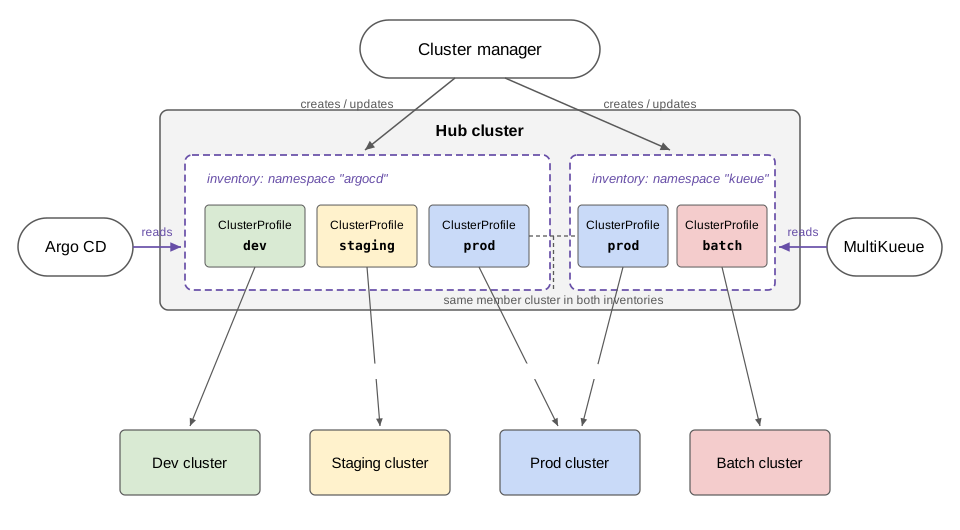
Cluster managers differ in how they choose the namespace where they publish ClusterProfiles. See Cluster Inventory API implementations for current behavior.
A cluster inventory is independent of a
ClusterSet. The clusterset.k8s.io property
records ClusterSet membership, not the inventories where a member cluster
appears.
Within an inventory, a member cluster SHOULD be represented by at most one ClusterProfile, although the same member cluster can appear in different inventories.
Identifying duplicate ClusterProfiles
Cluster managers SHOULD add the
multicluster.x-k8s.io/inventory-member-id label to each ClusterProfile. The
label MUST have a non-empty value when set, and cluster managers SHOULD keep the
value unchanged while the ClusterProfile represents the same member cluster.
The platform administrator SHOULD coordinate values on the hub so that
ClusterProfiles for the same member cluster use the same value and those for
different member clusters use different values.
A consumer SHOULD compare only the ClusterProfiles selected by its configuration, such as inventory namespaces, label selectors, or object references. It SHOULD deduplicate them only when its actions would conflict. Objects outside the selected set do not affect that consumer and need not be listed or watched solely for deduplication.
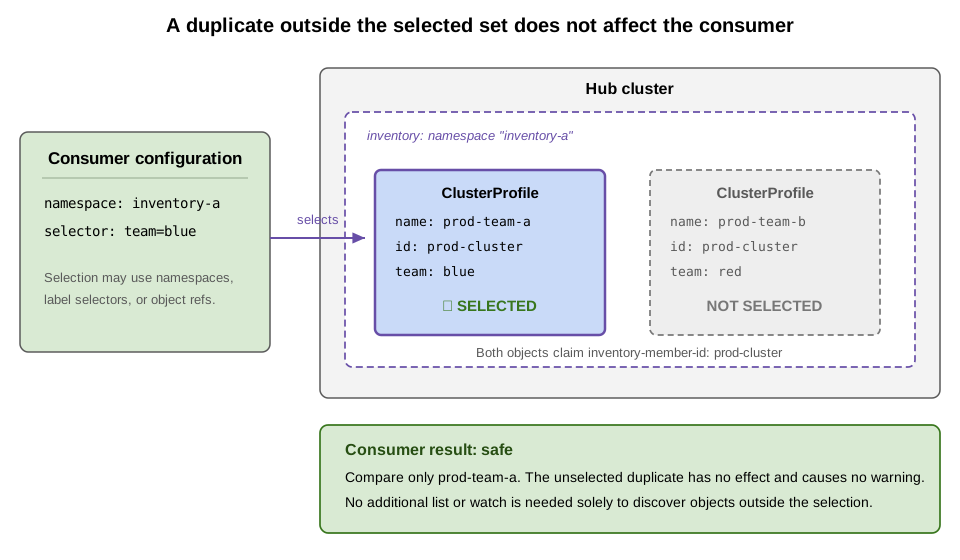
Selecting multiple ClusterProfiles with the same inventory member ID does not by itself require deduplication. If the consumer can act on all selected objects without the actions conflicting, it can act on all of them without a warning. If the actions would conflict, the consumer SHOULD act only on the oldest object. For conflicting objects in the same inventory, it SHOULD warn until the platform administrator removes the duplicates.
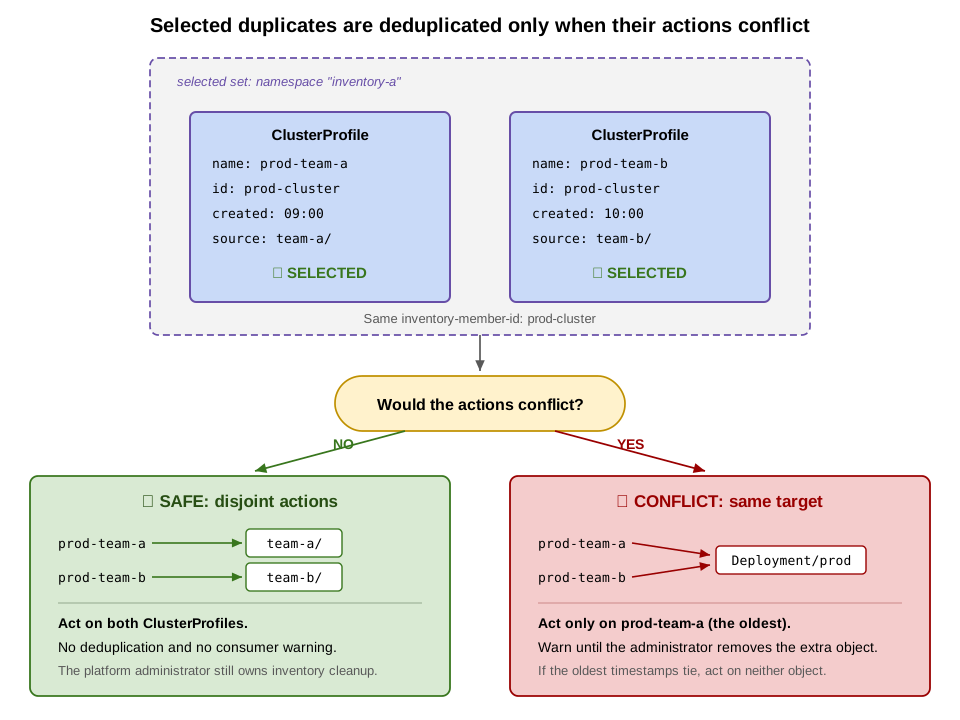
The following cases need additional handling:
| Situation | Behavior |
|---|---|
Two or more conflicting objects share the oldest creationTimestamp |
The consumer SHOULD NOT act on any of the tied objects. |
| The label is missing or empty | Treat it as absent; do not correlate or deduplicate the object using this mechanism. |
| The same ID appears in different inventories | The objects do not require deletion or a warning solely because they share the ID. If selected, the consumer still applies the conflict rule above. |
Regardless of consumer selection or conflicts, the platform administrator SHOULD delete all but one ClusterProfile for the same member cluster from each inventory. See KEP-4322 for the normative requirements.
Access to member clusters (status.accessProviders)
ClusterProfile describes a cluster, but it does not define a single universal way to authenticate to that cluster. Different environments have different credential sources (cloud IAM tokens, in-cluster Secrets, external identity systems, etc.).
To make multicluster controllers interoperable, status.accessProviders standardizes the reachability details for a cluster
and provides enough information for a consumer to select an external credentials provider mechanism (plugin) to obtain credentials.
- What
accessProvidersis: A list of named access provider entries. Each entry represents one way a consumer can connect to the member cluster. name: The access provider type identifier (for examplegoogleorsecretreader). Consumers can use this value to select a matching credential provider plugin.-
cluster: Connection details that reuse the kubeconfigClusterschema (for exampleserver,certificate-authority-data,proxy-url). -
What
accessProvidersis not: It is not a place to store credentials. Tokens, client certs, and other secrets should not appear in ClusterProfile. Consumers are expected to obtain credentials out-of-band, typically via an exec-style credential provider plugin as described in KEP-5339.
Selecting an access provider
status.accessProviders is written by the cluster manager (or its extensions) and treated as read-only by consumers.
If multiple access providers are present, consumers typically select an entry by name based on what credential provider plugins they support.
Plugin configuration (cluster.extensions)
Some credential providers need extra parameters (for example a clusterName) in order to fetch credentials.
These parameters should be per-cluster and non-secret, and must not include controller- or environment-specific data.
When plugin-specific per-cluster configuration is needed, use the Kubernetes client authentication API exec plugin mechanism.
See the reference for the exact schema and semantics:
client authentication API: Cluster.config for exec plugins
API Example
apiVersion: multicluster.x-k8s.io/v1alpha2
kind: ClusterProfile
metadata:
  name: some-cluster-name
  namespace: fleet-system
  labels:
    x-k8s.io/cluster-manager: some-cluster-manager
    multicluster.x-k8s.io/inventory-member-id: cluster-us-east
spec:
  displayName: some-cluster
  clusterManager:
    name: some-cluster-manager
status:
  version:
    kubernetes: "1.28.0"
  properties:
    - name: clusterset.k8s.io
      value: some-clusterset
    - name: location
      value: apac
  accessProviders:
    - name: secretreader
      cluster:
        server: https://api.some-cluster.example:6443
        certificate-authority-data: <base64-encoded-ca>
        extensions:
          - name: client.authentication.k8s.io/exec
            extension:
              clusterName: some-cluster-name
  conditions:
    - type: ControlPlaneHealthy
      status: "True"
      reason: AsExpected
      lastTransitionTime: "2023-05-08T07:56:55Z"
      message: ""
    - type: Joined
      status: "True"
      reason: ClusterRegistered
      lastTransitionTime: "2023-05-08T07:58:55Z"
      message: ""